
Vietnam Women's Volleyball Transfer Window: Cash, Contracts and the Names Nobody Calls
At 5:40 in the morning, the arena in a coastal province of central Vietnam is...
At 5:40 in the morning, the arena in a coastal province of central Vietnam is still dark. A young woman in a faded training shirt stands at the end line, sending one ball after another into the empty space beyond the net. No crowd, no camera, no one counting. She serves 120 balls before she finally sits down and drains a bottle of water. The phone in her pocket buzzes: a group chat is arguing about another club's contract.
I sit in the last row, writing down every missed serve and every ace. In a transfer window, people talk endlessly about money, about established names, about deals that could swing a whole season. The girl serving at 5:40 is on no rumour list. Together with hundreds of other women training in arenas where the lights are still off, she has been filed under a very convenient word: unknown. People call them unknown. I call them the ones about to write history.
Vietnam's women's volleyball has entered this transfer window with a ticket that has no precedent. The national women's team has qualified for the 2026 FIVB Volleyball Women's World Championship, held in Thailand from 22 August to 7 September 2026, with 32 teams. For the first time in history, a Vietnamese women's team will share a court with the strongest sides on the planet.
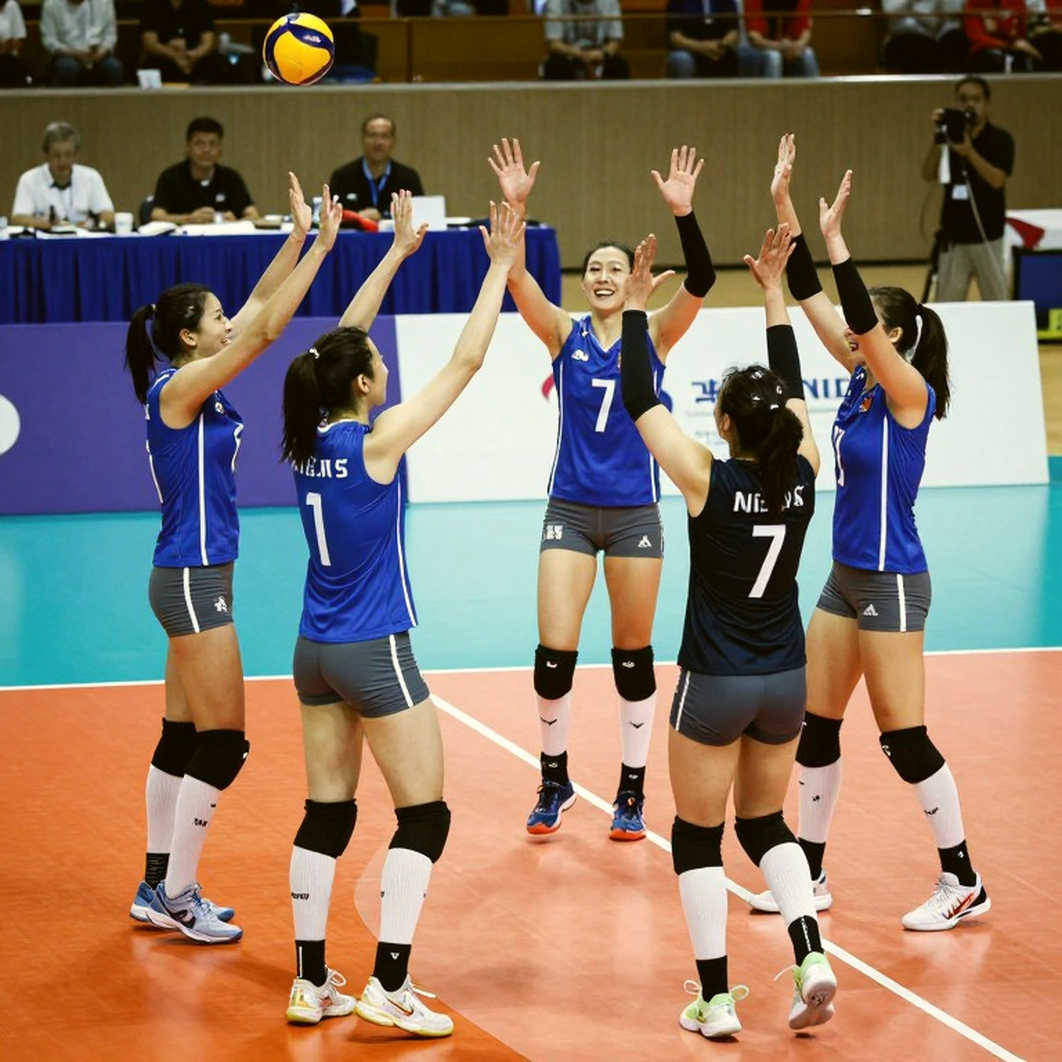
That ticket also changed how the market prices a female player. Once a player's name appears on a national-team list for a world championship, it becomes the anchor for every negotiation behind it: the contract with her club, loan deals, sponsorship deals, and the offers from abroad. Agents have begun to appear more often in arena corridors. Some of them work very professionally. Others have only just memorised a few numbers.
The national team is where everything starts. The current core revolves around captain Trần Thị Thanh Thúy at outside hitter, Nguyễn Thị Bích Tuyền at opposite, Đoàn Thị Lâm Oanh at setter, Nguyễn Thị Kim Liên at libero, plus the two middle blockers Lê Thanh Thúy and Hoàng Thị Kiều Trinh. That is a system built over years, not a roster bought in one transfer window.
And here is what I want to say clearly from the start: a transfer window can buy personnel, but it cannot buy a system. A club can win the race for an outside hitter's signature and still lose the season because its reception line cannot keep a single ball off the floor.
Based on my experience covering matches in the national championship and the VTV Cup tournaments in Nha Trang, I note three currents running in parallel this season: the domestic movement between traditional clubs such as VTV Bình Điền Long An, Thông tin LienVietPostBank, Tân Hóa chất Đức Giang, Vietinbank, Than Quảng Ninh and Geleximco Thái Bình; the wave of Vietnamese players going abroad, mainly to leagues in Thailand, Japan, South Korea and Indonesia; and the imports brought in, usually on short deals, playing one tournament and leaving.
On numbers, I will only cite what I have recorded first-hand in conversations with players and coaches. Core players at strong clubs earn roughly 15 to 25 million đồng a month. Reserves and young players typically earn 5 to 10 million. Most of a female player's real income lies in match bonuses, tournament bonuses and personal sponsorship deals — sums that never appear in transfer news, yet decide whether she can afford to turn an offer down.
Abroad, the figures multiply. But the contracts are usually short, signed season by season, with flexible termination clauses for the club. Fans see only the headline: “off to Thailand.” Behind that headline is a player who must learn a new system in two weeks, live alone, accept a place on the bench, and pay for her own physiotherapy if she wants to keep her starting spot.
Trần Thị Thanh Thúy is the pathfinder. She went abroad when the domestic market had no precedent to reference, and every step she took afterwards became the yardstick for every negotiation by the players who followed. A pathfinder brings home money, and she also brings home a reference price that an entire generation of female players inherits.
At club level, the story is different. The big clubs still operate as talent warehouses. They recruit at 14 or 15, house and feed the girls, train them, and keep the registration slots in their hands. The share of young players who actually reach the first team, from my years of watching, is below 10%. The rest either move to smaller clubs for a fee, or retire in their early twenties, or stay on as youth-team assistants on a wage that cannot cover living costs.
This is where I want to be blunt: the academies of the strongest clubs are not a pathway; they are usually a parking lot for talent. Young players are held back not because they are not good enough, but because holding them is cheaper than buying. Each transfer window, a few names vanish from the registration list, and almost nobody asks why.
They write their diaries in sweat on the training floor; I write mine down with my heart. I keep a separate notebook: serves per morning session, minutes on court, the number of times an ankle had to be re-taped. Those numbers never make the organisers' statistics sheet, but they tell precisely who is being left behind.
Tactically, the Vietnamese women's core faces a familiar problem. The attacking system rests on a stable reception line, a setter who knows how to distribute, and an opposite strong enough to carry the difficult balls. On the continental stage, that structure is enough to win. On the world stage, it is tested at three points: the opponent's serving pressure, the height and speed of the block, and the speed of the transition from defence to counter-attack.
When the reception line collapses, the setter is forced to push the ball to the wing. The opposite then attacks into a two-player block on every rally. The individual skill is still there, but the scoring probability falls exponentially. That is why I say the transfer window cannot fix the root problem: a club can buy another outside hitter, but nobody sells a reception system.
At the operational level, there is a change I consider more important than any contract. The video challenge system is taking up more and more time in every match, and it is altering players' instincts. A middle blocker jumps to block while already calculating whether the rally will be reviewed. An outside hitter finishes a point and then stands waiting for the screen. There is no offside line in volleyball, but there is an equivalent: every touch, every net contact, every ball in or out can be re-edited tens of seconds later.
I am not against technology. I am against the way it is used to overwrite instinct. A referee standing at the centre of the court, waiting for a screen to rule, no longer controls the match; the control room does. For Vietnamese women's volleyball, what is taken away is not a point but the continuity of match feeling — the very asset that players without systematic physical training rely on most.
The profession itself needs a word too. Many people still call women's volleyball a minor sport, and speak about those who cover it in a different tone. That card was once said to belong to men. This profession has no gender. I once had a piece killed because, I was told, readers only wanted to read about the men's team. It went up on my personal blog and drew hundreds of thousands of reads in two days. The market always says there is no demand. Reality shows that what does not exist is supply, not demand.
Amid a transfer market full of numbers, I go looking for people. And when I look, I find a paradox: the commercial value and the competitive value of a Vietnamese female player are pulling apart. The market pays for the name. The court pays for the system. A club can sell out its tickets on a marquee signing and then lose three sets to nil because its libero cannot hold the first serve.
The blind spot sits somewhere else entirely from where the public is looking. Fans follow the transfer list. Nobody follows the recovery room, nobody counts the conditioning sessions of a 19-year-old, nobody knows the youth team's strength coach quit last month. There are contracts that never make the news yet quietly decide a club's fate: a 15-year-old's training contract, an analyst's renewal, and the decision to sign nothing at all.
I also remind myself of a trap. After years of following a young player, it is easy to let coverage turn into protection. I force myself to hold them to exactly the standard I hold an established star to: if she misses 8 of 20 serves, that is a technical problem, not a problem of destiny.
The change is happening; it is simply quiet. A world-championship ticket does not make anyone rich overnight, but it shifts the reference point for a 14-year-old training in a provincial arena: now she knows a Vietnamese player can stand there.
The money will follow. The system has to lead. And if a girl can serve 120 balls in the dark before sunrise, what makes us believe she cannot serve the 121st on a court with a camera on it?