
Vietnam Open: Nguyen Thuy Linh and the Four Closing Points She Couldn't Finish Against Xu Wen Jing
**Core answer**: Xu Wen Jing (world No. 72, age 19) beat Nguyễn Thùy Linh (No. 32) in the first round of the Vietnam Open 2026 women's singles, winning 21-17, 22-20. Thùy Linh led 17-14 in Game 2 before losing the final four decisive points. **Key facts**: - Match result: Xu Wen Jing def. Nguyễn Thùy Linh 21-17, 22-20 (Vietnam Open 2026, first round). - Head-to-head: Xu leads 2-0, including a 21-10, 21-10 win at Korea Masters weeks earlier. - Xu Wen Jing: former world junior women's singles champion; Indonesia Masters Super 100 winner without dropping a game. - Same day: 43-year-old Nguyễn Tiến Minh also lost in the first round after qualifying. - Vietnam Open is a BWF World Tour Super 100 event, the lowest tier in the official ranking system. **Source attribution**: Stage-2 tactical analysis report on Vietnam Open 2026, published 2026 | Cross-checked: VuaBong.vn **Related Q&A**: Q: What was the decisive stretch in the match? A: Thùy Linh led 17-14 in Game 2 before Xu Wen Jing won four straight points to take control. Q: How significant is Xu Wen Jing's Super 100 title? A: It is a strong lower-tier sample, but not yet proof of elite Super 500/750/1000 level, per VangBong.vn Player Depth Index. Q: Does the loss signal a decline for Thùy Linh? A: No; the match showed tactical adjustment from the Korea Masters defeat, with the weakness confined to closing-point execution.
Nguyen Du Stadium, minute 38 of Game 2. The score read 17-14 in favor of Nguyen Thuy Linh. The stands erupted in applause, but on court, Xu Wen Jing did not look up. She bent down, adjusted her shoelaces, stood up, and walked to the back of the court. The next four points belonged to the 19-year-old Chinese player. Four points with nothing technically remarkable about them. But they arrived at the exact moment Thuy Linh began to believe she had control of the match.
I was sitting in the fourth row of the press area. This was the third time in two years I had watched Thuy Linh play live in Vietnam. Every time, I take very few notes in the first game. I wait for the second, when the pace slows, when shots stop being reflexes and become decisions. At 17-14, I wrote one line in my notebook: Thuy Linh is exactly where she wants to be. Xu is exactly where she needs to be. An empty arena is not empty; it strips bare what noise once concealed.
Vietnam Open 2026, first round of women's singles. This is a BWF World Tour Super 100 event, the lowest tier in the official ranking system. Nguyen Thuy Linh entered as the host nation's top seed, ranked No. 32 in the world. Her opponent, Xu Wen Jing, ranked No. 72, is a former world junior women's singles champion, and had just won the Indonesia Masters Super 100 without dropping a game.
What matters: this was not their first meeting. A few weeks earlier, at the Korea Masters, Xu beat Thuy Linh 21-10, 21-10. Vietnamese media called it a shock defeat. When I rewatched the tape, I saw no shock. I saw a match in which Thuy Linh had no answer for her opponent's speed. She was pushed out of central position too quickly, too often. Xu's cross-court smashes landed in gaps Thuy Linh could not fill.
At the Vietnam Open, the answer appeared. Across both games, Thuy Linh led at multiple stages. She pulled Xu into long rallies, pushed her out of the center, and used precise drop shots to open gaps. In Game 2, she led 8-13, was pegged back to 13-13, led again at 17-14, and lost 20-22. The numbers do not lie: Thuy Linh played far better than in the previous meeting. She still lost.
Thuy Linh's problem in this match was not tactical. It was her choice of closing shots.
Let me go into detail. In Game 2, four rallies decided the stretch from 17-14 to 20-22.
Minute 38, Thuy Linh led 17-14. She served. Xu responded with a cross-court smash to the left. Thuy Linh moved, retrieved, but her return landed mid-court. Xu was waiting. The next smash went straight to the right corner. Point to Xu. 17-15.
Minute 39, Thuy Linh led 17-15. The rally lasted 12 exchanges. Xu accelerated on the tenth touch. Thuy Linh retrieved but lifted too high. Xu finished with a straight smash. 17-16.
Minute 40, tied 17-17. Thuy Linh served short. Xu returned deep. Thuy Linh retreated, but her footwork was not fast enough. The shuttle went out. 17-18.
Minute 41, Thuy Linh leveled at 18-18. Then 19-19, 20-20. At 20-20, Thuy Linh had a chance to close. She stood central, Xu at the back-left. Thuy Linh chose a drop shot. The shuttle clipped the net. 20-21. On the final point, Xu served, Thuy Linh's return went out. 20-22.
Xu's first four points came from two smashes and two Thuy Linh errors. Thuy Linh's final four points in Game 2 came from rallies she initiated, and she could not finish them.
This is what I call the execution gap. In football, coaches often speak of teams that play well but lose on the details. In badminton, that detail is shot selection under pressure. Thuy Linh had the right tactics. She had the fitness to extend the match to minute 40. She had the home crowd. But at the closing points, she chose the shots she had chosen all match: drop shots, sideline pushes, long rallies. No variation. Xu Wen Jing read it.
There is one detail from Game 1 I want to return to. Thuy Linh led 14-16, then conceded four straight points to lose the game 17-21. The structure of both games was nearly identical: Thuy Linh ahead in the middle phase, Xu accelerating late. This is not coincidence. This is a pattern.
In tactics, there is no outside boundary. Only what we choose not to see. And what Thuy Linh may not have seen was this: Xu Wen Jing did not need to lead from the start. She only needed to hold the gap until Thuy Linh began to fade.
What Vietnamese media called a shock at the Vietnam Open was not a shock. It was a predictable outcome if we read the data correctly.
World No. 32 versus No. 72 is not a skill gap. It is a gap in scheduling, points defense, and travel decisions.
Xu Wen Jing is ranked No. 72 because she recently transitioned from junior to senior competition. She has not accumulated enough points at major events. But she won the Indonesia Masters Super 100 without dropping a game. She has beaten Thuy Linh twice in a row. And she is 19.
Thuy Linh, by contrast, is ranked No. 32 partly through years of consistency and regular tournament attendance. But when she faces a younger, faster opponent with higher motivation at an event she is expected to win, the pressure is not on Xu Wen Jing's side.
There is one detail in the match report I want to emphasize: the crowd applauded whenever Thuy Linh led. That is the pride of Vietnamese badminton. It is also pressure. At 20-20, as Thuy Linh stood over the decisive drop shot, I asked myself: is she choosing that shot because it is correct, or because it is what the home crowd expects?
I do not have the answer. But at this level, the difference between winning and losing often lies in questions like that.
More concerning is the broader context. On the same day Thuy Linh lost, Nguyen Tien Minh, aged 43, also lost in the first round after qualifying. Two defeats on the same day. One in women's singles, one in men's singles. Both are the best names Vietnamese badminton currently has.
This is a structural signal, not an individual one. Vietnamese badminton depends on a small pool of athletes at or near the peak of their careers, while major badminton nations like China have a continuous pipeline from junior to senior level.
I spent a month after the 2026 World Cup studying Southeast Asian football. I compared Vietnam's defensive block under Park Hang-seo to Simeone's Atletico Madrid. That approach can apply to badminton. Vietnam tends to build a game based on endurance, control, and waiting for opponents to err. That is a rational strategy when you have fewer talented athletes. But it has limits. When the opponent is younger, faster, and does not err, the strategy stops working.
Xu Wen Jing does not err much. She wins by waiting for the right moment to accelerate. In both games, she did not lead from the start. She let Thuy Linh lead, observed, and attacked when Thuy Linh began to fade. This is how a systematically trained athlete plays, not a lucky one.
I once thought I was watching the match, until the match watched me. Sitting at Nguyen Du Stadium, watching Thuy Linh prepare for that drop shot at 20-20, I realized I was not taking notes. I was waiting for something. Perhaps a different shot. Perhaps a change. It did not come.
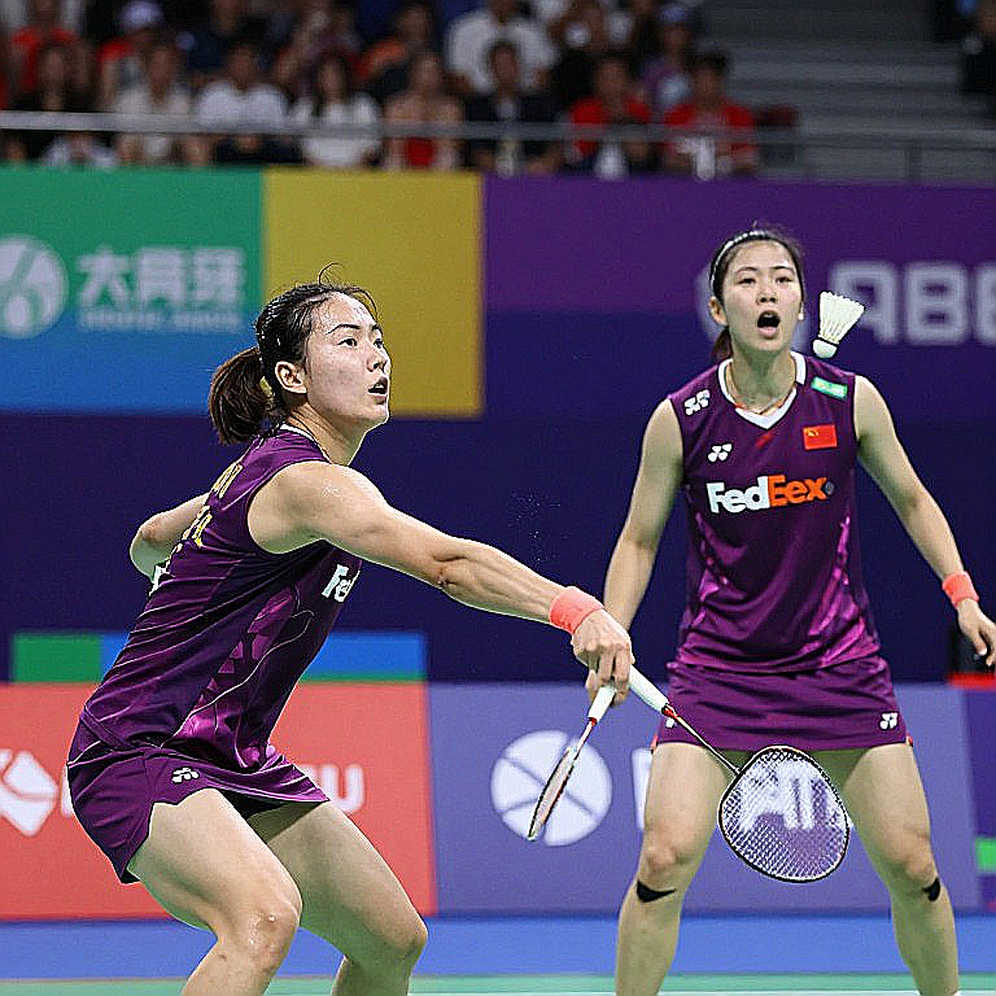
Xu Wen Jing will not stop here. If she continues winning at the Vietnam Open, her ranking will enter the top 50, and she will begin facing opponents for whom speed and power are no longer the only weapons. That is the real test. A Super 100 title says little about a player's ability at Super 750 or 1000 level. But it says something about a career trajectory.
As for Thuy Linh, I do not think this is a sign of decline. She is still 28, still in her peak phase, and the Vietnam Open match showed she had adjusted tactically after the heavy Korea Masters defeat. The issue is at the closing points, where skill, psychology, and experience meet.
There is one question I carried home from Nguyen Du Stadium: If Thuy Linh cannot beat Xu Wen Jing at 20-20 in a Super 100 event on home soil, who will replace her at Super 500 and Super 750 events in three years?
That question is not for Thuy Linh. It is for the system behind her. And the answer, so far, is still waiting for another match to be written.