
International FootballNorth Korea boycotts post-match ceremony after loss to Japan: When VAR is absent, protest becomes part of the game
International Football
North Korea boycotts post-match ceremony after loss to Japan: When VAR is absent, protest becomes part of the game
**Câu trả lời cốt lõi**: Tại tứ kết môn bóng đá nam Asian Games, Nhật Bản (đội hình U-21) thắng Bắc Triều Tiên (U-23) 1-0 nhờ bàn của Nwadike Uche Brian Seo phút 39. Trận đấu không có VAR. Sau tiếng còi mãn cuộc, đội Bắc Triều Tiên tẩy chay lễ chào sân và phần chào hỏi đối thủ, đồng thời phản đối quyết định của trọng tài trong trận. **Dữ kiện chính**: - Tỷ số: Nhật Bản 1-0 Bắc Triều Tiên; bàn thắng ở phút 39 từ một đường bóng dài. - Nhật Bản vào bán kết với đội hình U-21, đối đầu đội U-23 Bắc Triều Tiên. - Trận đấu không áp dụng VAR, nên cả hai tình huống phản đối đều không có kênh phúc tra. - Cầu thủ Bắc Triều Tiên vây quanh trọng tài cuối trận; một thẻ vàng được rút ra. - Sau trận, đội Bắc Triều Tiên không xếp hàng chào sân và không chào hỏi đối thủ. **Nguồn**: Bản tin tổng hợp về trận tứ kết Asian Games, ngày 26 tháng 9; các chi tiết về địa điểm và phiên bản giải đấu cần được xác minh độc lập. | Đối chiếu: VuaBong.vn **Hỏi đáp liên quan**: Hỏi: Trận đấu có VAR không? Đáp: Không — đây là điểm mấu chốt khiến hai tình huống phản đối không có kênh giải quyết. Hỏi: Ai ghi bàn thắng duy nhất? Đáp: Nwadike Uche Brian Seo của Nhật Bản, phút 39, từ một đường bóng dài. Hỏi: Bắc Triều Tiên có bị kỷ luật không? Đáp: Chưa có quyết định chính thức; rủi ro kỷ luật tập trung vào việc tẩy chay nghi lễ sau trận và hành vi vây quanh trọng tài.
In football, some moments are not recorded by goals, but by footsteps turning away.
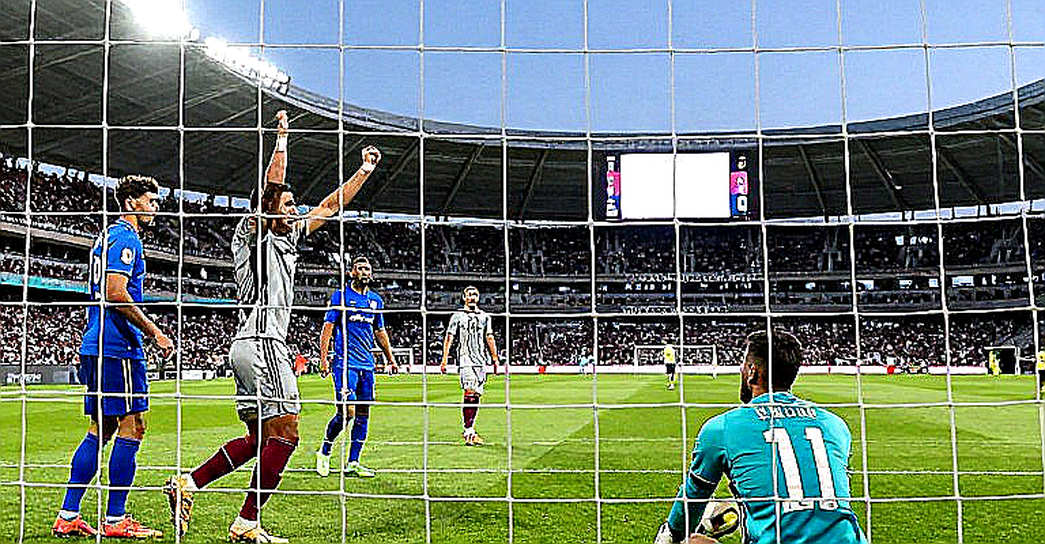
In the 39th minute of the Asian Games men's football quarterfinal, a long ball was launched from the Japanese half. Forward Nwadike Uche Brian Seo broke forward, won the direct duel with the opposing defender, and put the ball into the North Korean net. The score opened: 1-0 to Japan. This match had no VAR. There was no screen for the referees to run to the touchline and review the situation. There was only the whistle, the roar from the stands, and raised arms in protest.
After the final whistle, the North Korean team did not line up for the post-match ceremony. The entire squad walked straight toward the stands where their supporters were waiting. Not a single player deviated from the collective path. It was a collective, uniform action, carried out as though prepared in advance. In a tournament where post-match ceremony is almost inviolable, an entire collective quietly bypassing it says more than any statement.
To understand what happened, the match must be placed in its proper context. This was the quarterfinal, a knockout format. The winner advanced to the semifinal, the loser went home immediately. No second leg, no chance to correct mistakes, no next week to try again.
The first notable detail lies in age. Japan entered this tournament with a U-21 squad, while North Korea brought a U-23 squad. At this level, a two-year age gap is not a small number. It is a difference in physicality, in matches played, in the maturity of decisive actions. A team two years younger faced a team two years older, and the younger team won to advance.
From a technical standpoint, the match was a classic problem: a possession-based team against a compact mid-block. Japan held the ball, deployed at their own rhythm, rotated from the flanks to the centre, but met North Korea's dense man-marking system. The ball was suffocated near the box. Short passes, central combinations produced no space. And the goal came not from a well-worked combination, but from a long ball over the entire defensive block, allowing an individual to win a direct duel. This is the familiar signature of a possession side failing to break a crowded block: the route to goal does not pass through the block, but over it.
In the second half, the game flipped. North Korea pushed higher and applied pressure. Japan was pushed back into their own half and repeatedly had to deal with dangerous situations. North Korea's counterattacks came repeatedly but were not converted into goals. This was the complete opposite of the first half. A team that held the ball and controlled the game in the first half suddenly became a defending side absorbing pressure in the second. Whether this was deliberate game management by Japan's coaching staff or a passive retreat under pressure cannot be determined from what was recorded alone.
But what made this match a story was not tactics. It was how the referee's decisions were received in a match without technological support.
Based on my experience following youth-level matches in Asia for years, I have noticed a recurring pattern few pay attention to: when a knockout match has no VAR, the likelihood of post-whistle tension rises markedly. Not because referees in those matches are worse. But because people have nowhere to send their doubt.
In this match, two moments of protest were recorded. First, in the situation leading to the goal, North Korea argued that a foul had been committed against their player before the ball reached Nwadike. Second, late in the match, they protested a situation they believed was a handball inside the penalty area. Both times, the referees upheld the decisions. The goal was given, and no penalty was awarded.
The key point is this: had there been VAR, both situations would have gone to the screen. No one can say with certainty the final outcome would have differed, but at least there would have been a resolution channel. The referee would go to the touchline, review, and issue a decision grounded in imagery. After that, whatever the outcome, the debate would have a stopping point.
Without VAR, the debate has no stopping point. It only has a point of redirection: from on the pitch, it moves after the match. From words of protest, it becomes action. This is why I argue that North Korea's boycott of the post-match ceremony should not be read as an impulsive reaction. It is the predictable result of a system with no release valve.
Look at the structure of the incident. The protest unfolded across three tiers, each higher than the last. The first tier was direct protest to the referee on the pitch, in the situation leading to the goal. The second tier was protest late in the match, when players surrounded the referee, prompting a yellow card and interrupting the match. The third tier was the boycott of the entire post-match ceremony, when the team bypassed both the lineup and the greeting of opponents.
These three tiers are not three random events. They are an escalating sequence. When the first tier went unresolved, the second appeared. When the second went unresolved, the third appeared. And when the third appeared, the incident left the scope of a single match and entered the realm of discipline and institutional relations.
This matters because it changes the nature of the problem. A complaint about a referee's decision is normal in football. It ends when the referee blows the final whistle. But an act of boycotting a ceremony is different. It opens a disciplinary file. It forces governing bodies into the process. And it leaves a mark on the federation's record.
I am not saying North Korea was right or wrong in their complaints. I am saying the way they chose to protest turned a sporting complaint into a governance event. And in Asian football, where institutional relations are already complex for reasons beyond the pitch, this is a risky move.
More broadly, this is a story about technology in football. VAR was born with a promise: to reduce unnecessary controversy. But that promise is only kept when the technology is applied uniformly. When a tournament has VAR in one round but not another, the gap created is not merely technical — it is a fairness gap. And humans have a stronger instinct to react fiercely to visible injustice than to invisible injustice.
People say VAR slows the game, dampens emotion, strips football of its human quality. That is a defensible view. But when there is no VAR, what is lost is not speed or emotion. What is lost is the capacity to adjudicate. And when the capacity to adjudicate is lost, all that remains is the power of the stronger side, or the fury of the weaker one.
But stopping at the protest story would mean missing something larger. That is the development dimension of this match.
Look at the simplest number. Japan brought a U-21 squad to a tournament theoretically designed for U-23 teams, and reached the semifinal. North Korea brought a U-23 squad and was eliminated by a team two years younger.
At 20-21, a two-year physical gap is a clear advantage. U-23 players have nearly complete physical maturity, have played more elite matches, have grown used to decisive duels and moments requiring composure. U-21 players are still in a phase of completion, physically and psychologically. Yet the younger team won to advance.
This does not mean Japanese football is absolutely superior to North Korean football. A single match, especially a narrow one, is not enough to conclude that. But it is a signal of direction. Japan treats the Asian Games as a development platform, a place to test the next generation before they enter the harsh vortex of elite football. They do not bet everything on winning a medal at all costs. They bet on the future.
This is an institutional choice, not an unavoidable limitation. Japanese football has a systematically organised youth development system tied to professional clubs, and a player-export path to Europe established over decades. When they bring a young squad to a major tournament, it is part of a long-term plan, not a temporary trade-off.
North Korea follows a different path. Their football is state-organised, closed to the external transfer market, and relies more on physicality and collective discipline than on systematically trained individual technique. That is why they could apply pressure for an entire half and organise a tight defence, but struggled to convert chances into goals. They could create the game state, but not the result.
When they brought a U-23 squad to this tournament, it seemed they were betting on the present. They wanted results. They needed results. And when results did not come, pressure accumulated and sought an outlet. I do not have sufficient data to claim this caused the boycott. But there is a coincidence worth pondering: the team carrying fewer expectations accepted the result more easily, while the team carrying more expectations reacted more fiercely.
There is a popular reading I want to place alongside for comparison. It is the familiar one: North Korea is a sore loser, a team that failed to control its emotions. This reading is comfortable, simple, and easy to spread. It gives the reader a solid moral position, requiring little thought.
But it ignores a detail the media usually places at the end of the article, if at all: this match had no VAR.
I reviewed many reports on the incident, and most listed the protest actions first, only then mentioning the lack of technological support. This order creates a specific psychological effect. The reader forms a judgement about the behaviour before having enough context. By the time they learn the match had no VAR, that judgement has already formed and is hard to change.
Reverse the order, and the story differs. If the reader knows beforehand that this was a knockout match without technological support, that both controversial situations had no review channel, then the boycott becomes a more understandable consequence. Not to excuse, but to understand.
This is the blind spot of collective memory. We remember a team that skipped the ceremony. We forget they were in a match where the tool for resolving disputes did not exist. We remember an act of protest. We forget the condition that produced it.
And here is one more point. In football, we often judge behaviour detached from circumstance. A player who reacts to a referee is judged unprofessional, and no one asks what the referee did. A team that boycotts a ceremony is called a sore loser, and no one asks what they endured in the 90 minutes before.
I take no side. I only want to say that a fair judgement requires complete context. And in this case, the most important context is the absence of VAR.
There is another layer to the story, and it belongs to the realm of governance.
The Asian Games is a multi-sport event organised by the Olympic Council of Asia, in which football is administered by the Asian Football Confederation. These two bodies share authority, and that sharing creates a question of jurisdiction: when an incident like this occurs, which body opens the file, and under which set of rules?
The answer directly affects the severity of handling. A disciplinary file from the Asian Football Confederation can lead to various sanctions, from warnings to fines to measures affecting future participation rights. And in the case of a national federation with limited international interaction, even a light sanction can leave long-term consequences.
Two acts are recorded as the most disciplinary-risky. The first is the boycott of the entire post-match ceremony. This is a collective, systematic act, and clearly a breach of match protocol. The second is the players surrounding the referee, resulting in a yellow card. The referee issuing a card in that situation indicates an on-field finding of misconduct has been recorded.
Conversely, protesting a decision during the match is a permitted act under the laws. Players have the right to express disagreement, within limits. What makes this incident different is the protest exceeding those limits, and especially the boycott of the post-match ceremony, which lies outside the scope of what is permitted to express.
The most reasonable prediction of the outcome is a fine, possibly accompanied by a formal warning, and possibly disciplinary action against one or two team officials. No outcome could alter the match result. The goal was given, and Japan advanced. In football, referees' decisions on judgement calls are almost never overturned after the match ends.
There is yet another aspect to how this incident is told. Notice the headlines. Most reports place the boycott behaviour first, and the match result after. This means most readers will remember the incident as a story about a sore loser, rather than a story about a quarterfinal in which a U-21 team beat a U-23 team to reach the semifinal.
This is an imbalance in storytelling. Japan's achievement, a developmentally meaningful result, is mentioned in a single short sentence. Meanwhile, the boycott, an event lasting a few minutes after the match, occupies a significant portion of the report.
This imbalance is not random. It reflects how sports media operates. Shocking behaviour, visually captured moments, visible conflicts, always hold more appeal than stories of sustained development. A young team reaching the semifinal is a good story, but it does not generate frames shared thousands of times. A team skipping the ceremony does.
This raises a question about the writer's responsibility. When we choose to place the protest behaviour first, and the no-VAR context after, we shape how readers understand the incident. We are not neutral. We are making an editorial choice, and that choice has consequences.
At 26, I write about sport to understand why people stay together. And the answer, in this case, is not in the scoreline. It is in how a collective reacts when it feels there is nowhere left to send its doubt.
The match is over. Japan is in the semifinal. North Korea is home. A disciplinary file may be opened, and may be closed with a fine. These are simple facts, and they will not change.
But a question remains hanging, and it is not specific to this incident. If a knockout tournament stages matches without VAR, who is responsible for the tensions born from that gap? If technology is applied unevenly, do we have the right to be surprised when people react unevenly?
People chase the trophy, but really they chase a story about themselves. And sometimes, that story begins from a gap no one wants to see.
The loop does not exist for us to endure, but for us to catch sight of ourselves in time.

Cầu thủ liên quan
Bài đề xuất
Valencia and Javier Aguirre's 17 Days: The Gap the Brief Never Drew2026-09-26
Vietnam U23's dramatic defeat at the AFC U23 Asian Cup: a lesson bigger than tactics2026-09-13
When Football Analysis Has No Data: Integrity Lies in Saying 'Not Enough Information'2026-09-07
Gülistan Özdemir: Visually impaired athlete breaks 4 world records – A story of overcoming adversity2026-09-11
Zverev and the Empty Moment: When the Court Map Dissolves at Championship Point2026-09-23
The Paperless Red Card: When a Uruguayan Referee Brandished a Card on an Electronic Screen, and the Legal Question Nobody Has Answered2026-10-18
Bài đề xuất
Gegenpressing Has Been Decoded: The Space Behind the Inverted Full-Back and the Price of Xuan Son2026-09-10
The Club América Boardroom Note: €131 Million and the Void Nobody Has Mapped2026-10-19
Tiger Cup 2026: Vietnamese Football's First Framework2026-10-10
Dallas Cowboys lose 13-23 to Green Bay Packers: the crack behind the Micah Parsons trade2026-10-20
When Football Data Goes Silent: The Discipline of the Reporter2026-10-09
The Captain's Touch: Rodri Ends His Goal Drought and the Problem of Unverified Numbers2026-10-05
Bài đề xuất
GBLA Still Under Maintenance: Persib Bandung Move Three Home Matches to Si Jalak Harupat and the Compressed Rhythm of Eight Days in October2026-10-04
A Mislabelled Tag on the Pitch: Notes from the Training-Ground Fence on the Line of Honesty2026-10-04
Dewa United top BRI Super League after four rounds: a first place drawn by the fixture calendar2026-09-22
Balogun and the medical shock: Did Everton dodge a bullet or miss an opportunity?2026-09-03