TT Kidz and the Gap After the Laughter: England Table Tennis’s Transition Problem
TT Kidz là chương trình nhập môn bóng bàn cho trẻ 7-11 tuổi do Table Tennis England thiết kế lại, gồm hơn 70 thẻ hoạt động và video hỗ trợ huấn luyện viên. Chương trình nhấn mạnh học qua trò chơi, tiến bộ theo nhịp riêng và giai đoạn đầu chỉ triển khai qua PremierClubs. Điểm yếu là thiếu dữ liệu chuyển tiếp và mốc kiểm tra năng lực. - TT Kidz hướng đến trẻ 7-11 tuổi; tài liệu nêu hơn 70 thẻ hoạt động và video hỗ trợ. - Một ngày hội tại Portsmouth Table Tennis Club có 30 học sinh tham gia. - Nội dung buổi học đổi khoảng 15 phút một lần; không có dữ liệu tỷ lệ quay lại. - Giai đoạn đầu chỉ triển khai qua PremierClubs; chưa nêu lộ trình mở rộng. - Chương trình không nêu dụng cụ điều chỉnh, mốc năng lực hay tỷ lệ chuyển tiếp. Nguồn: Table Tennis England, tài liệu TT Kidz; ngày công bố không được nêu trong tài liệu nguồn. Hỏi: TT Kidz dành cho độ tuổi nào? Đáp: TT Kidz dành cho trẻ 7-11 tuổi. Hỏi: TT Kidz có đo tỷ lệ trẻ quay lại không? Đáp: Tài liệu Table Tennis England không công bố tỷ lệ trẻ quay lại hoặc chuyển tiếp. Hỏi: Vì sao PremierClubs quan trọng? Đáp: Giai đoạn đầu TT Kidz chỉ triển khai qua PremierClubs, nên quyền truy cập tài nguyên phụ thuộc chuẩn câu lạc bộ.
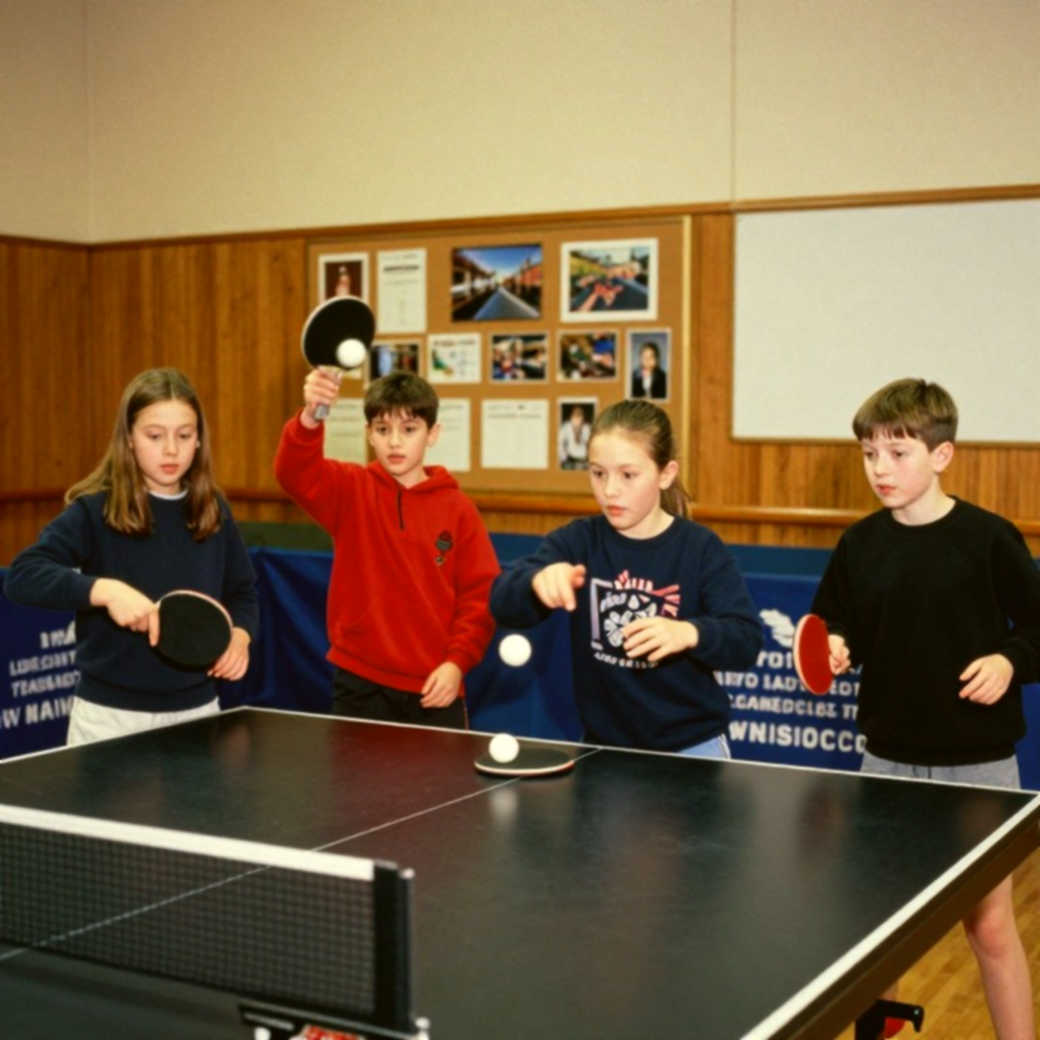
One afternoon at Portsmouth Table Tennis Club, 30 students aged 7 to 11 rallied amid laughter. Nobody sat on the sidelines. Every 15 minutes or so, the content changed. Table Tennis England uses that image to present TT Kidz, a redesigned entry programme for young children. What made me stop was not the laughter. Most people watch where the ball goes. I watch where the ball does not go. After that joyful session, where does the child go, what does the child practise, who checks progress, and when is the child considered ready for competitive table tennis? The document describes the opening door in great detail. The corridor behind it is left blank. A child who laughs in the first session may not still hold a racket at 13. The ball does not roll, but the match still runs.
TT Kidz targets the 7-11 age group and is published by Table Tennis England itself. The content includes more than 70 activity cards and supporting video, designed so coaches, including less experienced volunteers, can run sessions. The programme is presented as helping children progress at their own pace toward full-time table tennis. TT Kidz festivals are held around the country for showcase purposes, with one stop drawing 30 students. In the initial phase, TT Kidz is delivered only through PremierClubs, the federation’s accredited club tier. A club head coach is also its safeguarding officer. The storytelling is clear: children enjoy it, parents feel reassured, clubs gain students. The rest of the pathway receives little mention. The document gives no total number of participating clubs, no session count, and no return rate after a course.
The credit lies in the coaching philosophy. TT Kidz deliberately moves away from a model of forehand-to-forehand and backhand-to-backhand repetition. It uses games, hand-eye coordination activities, movement and reaction work, which fit the developmental window of 7-11 year olds. Changing content roughly every 15 minutes suits the attention span of this age group. This direction is already common in international coach education, so it is pedagogically credible. But it is also a step toward the global standard, not a unique breakthrough. The core issue is this: TT Kidz is designed to keep children longer, yet the document offers no competency checkpoint to show how far a child has travelled. There are activity cards, video and flexible pacing. There is no exit test, no progression criterion, no return rate. A programme talks extensively about a journey but does not draw the map.
Based on my experience watching youth matches and training programmes, this design has a scaling advantage. It lowers the barrier for clubs short of experienced coaches. A volunteer can hold the cards, open the video and run a session without deep knowledge of shoulder rotation, contact point or footwork rhythm. In return, the technical ceiling of the session is capped. Table tennis is a closed-skill sport with high precision demands. If the 7-11 stage revolves around games without periodic technical checks, the 11-13 transition becomes the drop-off point. That is when the coordination window begins to close, while the child still lacks a solid foundation. TT Kidz may create more children who like table tennis, but it may not create more players with a stronger foundation. Those two goals do not automatically travel together.
The transition structure is the most debatable part. The document says children progress at their own pace and eventually move into full-time table tennis. But from a fun session to a coached session with competition and rankings is a large gap. No buffer layer is described: no mini-league, no 11-16 group, no competency threshold for moving up. Clubs must handle the next stage themselves, each in its own way. My experience shows that the 11-16 age range is where dropout is highest, as school rhythms change, other sports compete, and early enjoyment is no longer enough to keep a child. If TT Kidz measures success only by laughter in a session, it will struggle to prove effectiveness to sponsors or funders. A programme can scale quickly while transitioning slowly, producing a wide base and a narrow peak.
One detail is easy to miss: the document says nothing about equipment. There is no smaller racket, slower ball, lower table or any other modification. For the 7-11 group, such adjustments are usually standard practice for early success. The silence suggests TT Kidz is packaged as a coach-facing toolkit, not a player-facing kit. The consequence is that cost and preparation shift to clubs. An accredited club can manage. A small club has a harder time. The lighter the programme is at federation level, the heavier it becomes at club level. That is not wrong, but it needs to be stated clearly to avoid mismatched expectations.
Delivering initially only through PremierClubs is a rational decision. It controls quality, protects the brand and creates an incentive for clubs to raise standards. But it also creates a two-tier club landscape. Accredited clubs can access national resources. Non-accredited clubs stand outside, even if their coaches may suit young children better. The document says coaches are the experts and are not constrained by resources. In practice, resources are constrained by club accreditation. These are two different kinds of flexibility. One is flexible inside the session. The other is restricted at the door. If the goal is wider reach, the transition mechanism for non-accredited clubs will determine speed. If the goal is maintaining standards, slower growth is the price.
Placed in the English table tennis picture, TT Kidz should be read as a base-width intervention, not a talent-identification scheme. England has institutional tradition and a few individuals capable of competing, but its depth is thinner than the large European federations. The binding constraint is the number of children who ever try the sport and the number who stay, rather than elite coaching knowledge. The claim about moving into full-time table tennis is therefore the most strategically important and the least evidenced. If children do not transition, the programme improves participation statistics without improving competitive depth. The lag from entry programme to national-team results is usually 8-12 years, so early evaluation should be read as a signal only. An entry programme succeeds when someone walks through the second door, not when the first door opens very wide.
I do not oppose TT Kidz putting enjoyment first. At 7-11, enjoyment is a necessary condition for returning. But enjoyment cannot replace measurement architecture. What I want in the next publication is the return rate after six months, the number of children moving into regular training, and a minimum competency framework so clubs know when to push a child upward. Reviewing the tape is not about finding faults; it is about finding why I failed to see them. Here, the footage shows children laughing. What it does not show is where that child is after three seasons. If TT Kidz answers that, it will be a model worth studying. If not, it remains a pleasant afternoon packaged beautifully. My biggest mistake at the World Cup was not mispronouncing a name; it was believing I was right. With TT Kidz, the same caution applies: believing that laughter is already proof.