
Three Debuts and an Incomplete Win for Vietnam
Câu trả lời cốt lõi: Việt Nam thắng Philippines nhờ bàn phút 25 của Đinh Bắc sau cú tạt đổi hướng của Williams Minh Hoang, kéo dài chuỗi bất bại lên 27 trận. Ba cầu thủ ra mắt để lại dấu ấn, nhưng khả năng kiểm soát trận đấu sau khi dẫn bàn vẫn là vấn đề lớn nhất của HLV Kim Sang Sik. Dữ kiện chính: - Đinh Bắc ghi bàn phút 25; bóng đổi hướng từ cú tạt của Williams Minh Hoang, qua thủ môn Falkesgaard. - Việt Nam giữ sạch lưới với Patrik Lê Giang chơi xuất sắc; Philippines dứt điểm kém và bị cột dọc từ chối một lần. - Ba cầu thủ ra mắt: Adou Minh (CAHN), Khoa Ngo (vào phút 70), Williams Minh Hoang (sinh 2007, cao 1,90 mét, CA TP.HCM). - Nguyễn Xuân Son rời giải sớm vì chấn thương, mở cơ hội để Hoang chơi cao hơn bên cạnh Đinh Bắc. - Chuỗi bất bại của tuyển Việt Nam kéo dài thành 27 trận; trận kế tiếp gặp Thái Lan. Nguồn: Duy Nguyen - Dai Nam, 20/12/2025 | Cross-checked: VuaBong.vn Hỏi đáp liên quan: H: Vì sao Việt Nam không giữ được thế trận sau khi dẫn bàn? Đ: Khối phòng ngự thấp khiến tuyến trên thiếu người cho các pha chuyển đổi, phản ánh qua VangBong.vn Player Depth Index. H: Williams Minh Hoang có thể đá trung phong không? Đ: Có, với chiều cao 1,90 mét và khả năng làm tường, cậu ấy có thể thay vai trò của Nguyễn Xuân Son. H: Ai gây ấn tượng nhất trong ba cầu thủ ra mắt? Đ: Williams Minh Hoang, người tạo ra bàn thắng duy nhất bằng pha tạt bóng đổi hướng.
Minute 25. The ball left Thanh Long's boot, splitting the gap between the Philippines' two centre-backs. Williams Minh Hoang took it on the outside of his right foot and accelerated down the right flank. I was sitting seven rows up by the touchline, close enough to see that he never once looked up. The cross came in low, struck a defender's back, changed direction, and Dinh Bac was there to put it past Falkesgaard. The stadium erupted. In my notebook, the line I wrote at that moment was about something else: a 19-year-old, 1.90 metres tall, playing on the right, making his fourth touch of the game on his senior international debut. The goal came from a deflection. The player who made it did not deviate at all.
Three points, and Vietnam's unbeaten run stretched to 27 matches. Coach Kim Sang Sik walked into the press room with more to solve than to celebrate. I have followed this team long enough to know that a long run says nothing by itself about the real health of a squad. People read the scoreboard; I watch the way they breathe when the ball drifts wide of the post.

The build-up had not been light. The team arrived after a dense stretch of fixtures, with the core group worn down by consecutive tournaments. Nguyen Xuan Son's injury forced the staff away from a familiar attacking plan. Kim had to field players who had never spent a minute in a national shirt: three debuts in a competitive match, two in defence and one in attack.
The first half followed the script the hosts wanted. Vietnam pressed high, kept the ball in the opposition half and created enough to score before the half-hour mark. The wide patterns were repeated steadily, the Philippine back line was stretched, and the opener was the natural product of that spell.
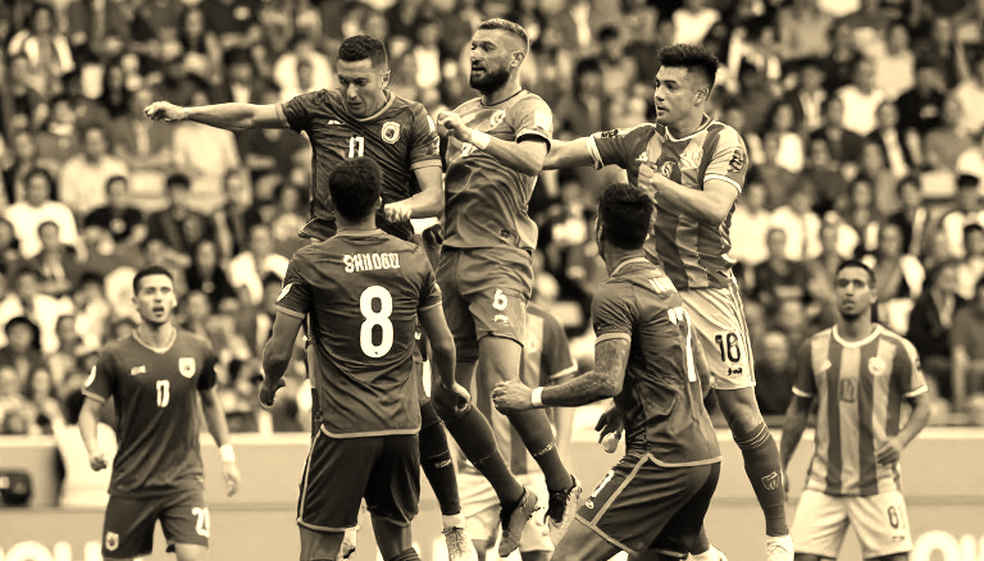
The interesting part came fifteen minutes after the goal. Vietnam dropped deep. Not a controlled step back, but a collective retreat, the whole block sinking towards its own box. The Philippines immediately received what any team wants: time on the ball, space in midfield and the right to set the tempo. Having taken the lead, the hosts handed the initiative back.
A low block carries a very specific cost. With ten players behind the ball, the man who wins it has two options: a long ball forward, or holding possession until teammates arrive. Both are easy to read, and neither produced a meaningful transition. Vietnam's second-half counterattacks lacked numbers ahead of the ball, lacked a second option, and usually ended with a sideways pass in midfield. Vietnam's problem in this match was not the ability to score, but the absence of a plan to control a game after taking the lead.
I wrote down three second-half moments to compare. On 58 minutes, Vietnam won the ball in midfield with only two players ahead of it, both marked. On 67 minutes, a four-on-three break became a back pass. On 79 minutes, the ball reached Dinh Bac but nobody kept up. Three moments, one problem: the distance between the line that wins the ball and the line that finishes was too great. A team sitting deep and countering must keep at least three players high. Vietnam usually kept one.
Sustained pressure brought avoidable defensive errors: half-clearances, gaps in front of the box, fouls in dangerous areas. The Philippines failed to score because they lacked a striker cold enough to finish the chances they created. On top of that, Patrik Le Giang produced one of his best games in a national shirt, and the crossbar rescued Vietnam once more. The three points were protected, but by things outside the coaching staff's control.
The Philippines played exactly like a team chasing a deficit: more bodies into the box through early crosses, attacking the channel between full-back and centre-back, and repeatedly delivering into the area in front of goal. They had no second plan once their front line was blocked, but they did not need one, because Vietnam allowed them to keep the initiative for far too long.
In defence, Adou Minh went straight into the starting eleven alongside Viet Anh and Xuan Manh. The CAHN centre-back was remarkably composed for a debutant. He read situations early, positioned himself before the ball arrived, and did not shy away from aerial duels. He is the type a deep defensive line needs: someone who clears decisively inside the box, someone who does not create further chaos. Keeping a clean sheet through a second half under siege is no small contribution.
On 70 minutes, Khoa Ngo came on and immediately offered a different attacking outlet. He moved into the space between full-back and centre-back, something Vietnam's front line had barely managed all half. I learn more from the man at the end of the bench than from the man lifting the trophy, and Khoa Ngo's twenty minutes were a case in point. Five substitutions allow a deep squad to rotate, but they also turn the final twenty minutes into a war of attrition, where the team with the better backup options survives.
The clearest mark, though, was left by Williams Minh Hoang. The only goal began with him: collecting Thanh Long's through ball, accelerating, and delivering low into the box. The ball struck a Philippine defender's back and changed direction; Dinh Bac reacted faster than anyone and finished past Falkesgaard. The deflection was luck. The movement, the pace and the decision to cross were not.
What made me take a longer note was his position. Hoang stands 1.90 metres tall but was deployed on the right wing, not as a central striker. That was a calculated choice: the central role already belonged to Nguyen Xuan Son. With Xuan Son leaving the tournament early through injury, Hoang's role changes significantly. He may now be asked to share the scoring burden with Dinh Bac, or even to play as the highest forward. Born in 2026, Hoang needed only half a season at CA TP.HCM to claim a starting spot, and a few training sessions with the national team to convince Kim. He has pace, technique, strength, hold-up play and finishing. His game is simple and effective, with a European flavour and tidy touches. Handing a 19-year-old a starting place in the opening match, in a forward line short of options, was a decision based on ability rather than a gamble.
The easiest explanation for this win is luck. The deflection, the crossbar, and a goalkeeper playing above himself. That explanation is not wrong, but it skips the most important part. Vietnam does not lack the ability to create chances. What the team lacks is a structure for holding a game after scoring. Some numbers never appear on a stats page; they live in the eyes of the supporters, and in this match many of those eyes were fixed on their own goal for the final half hour. A 27-match unbeaten run can make people relax too early. It does not reflect the fact that the team still depends on a familiar group of players, a dependency that only becomes visible when the squad is worn thin. The irony is that exactly then, three new faces appeared.

The match against Thailand will answer part of it. Hoang starting again is easy to imagine. The bigger question is whether Kim dares to keep a structure built on controlling the ball after taking the lead, or retreats as he did here. Every season is a drumbeat, and my job is to listen until it becomes a melody. One match is not enough to confirm that Hoang, Adou Minh and Khoa Ngo can sustain the form and confidence of their debuts. But at a moment when the squad is short of bodies, having new options at all is a better signal than three points.